01 — Platform Architecture

The architecture of the Operating System for Physical Work.

Intelligence that understands the machine it runs on — a universal retrofit layer plus a four-tier intelligence stack, coordinated by an operations OS that runs across construction, cleaning, logistics hubs, and mining sites.

02 — Six Worker Classes

Six sources of physical work — one operating system.

The OS coordinates six worker classes across every site: humans, retrofit robots, purpose-built robots, humanoid robots, AI agents, and wearables. Each class is a data source for the flywheel and an execution channel for the operations layer.
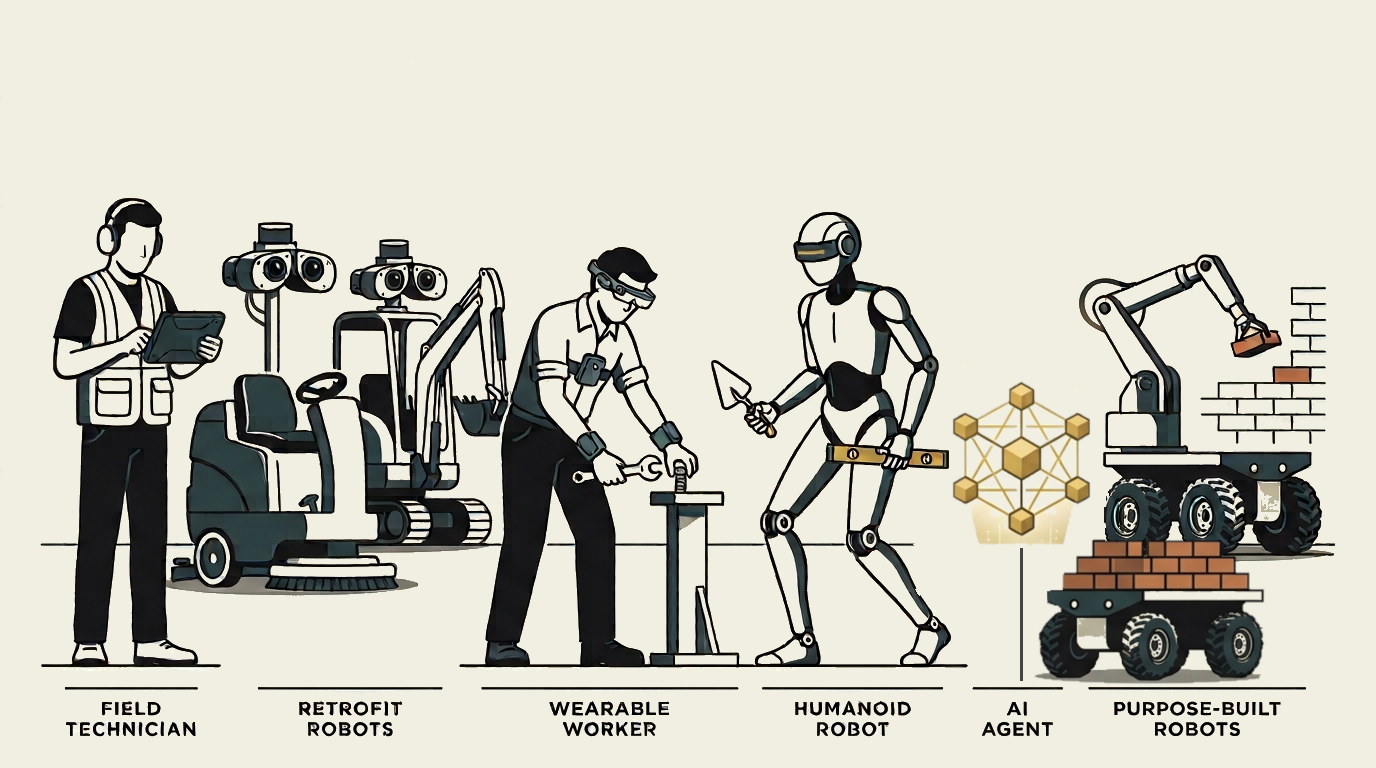
Six worker classes coordinated by the OS: field technician, retrofit robots, wearable-equipped worker, humanoid robot, AI agent, and purpose-built robots.
Operating System for Physical Work
03 — Retrofit → L1–L4 Intelligence Stack

Hardware-first, from the ground up — then intelligence.

Foundation models can't sense a scrubber's brush pressure or a mining haul truck's articulation angle. The stack starts with a universal retrofit — one hardware kit across 238 machine types and 45+ OEMs — and layers four intelligence tiers on top. Each tier is what most robotics companies stop at. The OS delivers all four.

Retrofit

Universal Retrofit Platform

Sensor pod, Jetson compute, actuator bridge, safety controller. One hardware kit that fits any machine — including humanoids on wheels.

238 machine types
45+ OEM brands
15,000+ variants
L1

Actuator Intelligence

The machine physically does the work — steering, brush pressure, arm extension, vacuum control.

Real-time control
joint-level data
L2

Task Intelligence

Completes whole tasks, not just motions — "make the floor clean," not "drive route A."

Task-graph planning
outcome-graded
L3

Environment Intelligence

Understands the world — forklifts, weather, shift patterns, safety zones. 18,000+ catalogued edge cases.

Perception + CV
edge-case library
L4

Operations Intelligence

Delivers the business outcome — SLA tracking, scheduling, fleet coordination, auto-reporting. One field support tech per site.

SLA · scheduling
NOC — 1 : 50 machines
04 — Six Modules

Six modules describe what the OS does.

Frameworks, Systems, Agents, Tools, Playbooks, Processes. Each module composes into the OS the way subsystems compose into a classical operating system. Tap any card to see what it contains.

01
Foundational Abstractions

Frameworks

The base classes — worker classes, autonomy stack, edge-case taxonomy, site maturity curve.

  • L1–L4 Autonomy Stack
  • Edge Case Taxonomy (Types A–E)
  • Site Maturity Curve
  • FSA Decision Framework
  • BOM Inversion
Show sub-items
02
Runtime Systems

Systems

The engines — navigation, perception, agent runtime, predictive maintenance, SLA, edge-case pipeline.

  • Navigation Server (SLAM · path planning · 45+ OEM types)
  • Perception Engine (Vision · LiDAR · ultrasonic · touch)
  • Agent Runtime (hosts all agents · A2A messaging)
  • Predictive Maintenance Engine
  • SLA Engine (compliance · penalties · reports)
  • Edge Case Pipeline (ingest · tag · train · deploy)
Show sub-items
03
Autonomous Actors

Agents

Distributed autonomous agents — site ops, FST mobile, NOC operator, edge-case curator.

  • Site Ops Agent
  • FST Mobile Agent
  • NOC Operator Agent
  • Edge Case Curator
  • Fleet Orchestrator
Show sub-items
04
Interfaces

Tools

The dashboards and applications — customer portal, NOC console, fleet manager, task planner.

  • Customer Portal
  • NOC Console
  • Fleet Manager
  • Task Planner
  • Reporting Suite
  • Edge Case Explorer (Smiling Buddha · 18K+ catalogued)
Show sub-items
05
Standardized Procedures

Playbooks

Repeatable ops — site onboarding, exception routing, safety response, quality audit.

  • Site Onboarding Playbook
  • Exception Routing Playbook
  • Safety Incident Response
  • Quality Audit Cycle
  • SLA Recovery Protocol
Show sub-items
06
Continuous Loops

Processes

The operational cadence — data ingest, training, deployment, validation, iteration.

  • Data Ingest Loop
  • Training Cycle
  • Deployment Cadence
  • V0→V3 Validation
  • Iteration Cycle
Show sub-items
05 — The Data Flywheel → Full Site Automation

The flywheel builds intelligence. Intelligence drives Full Site Automation.

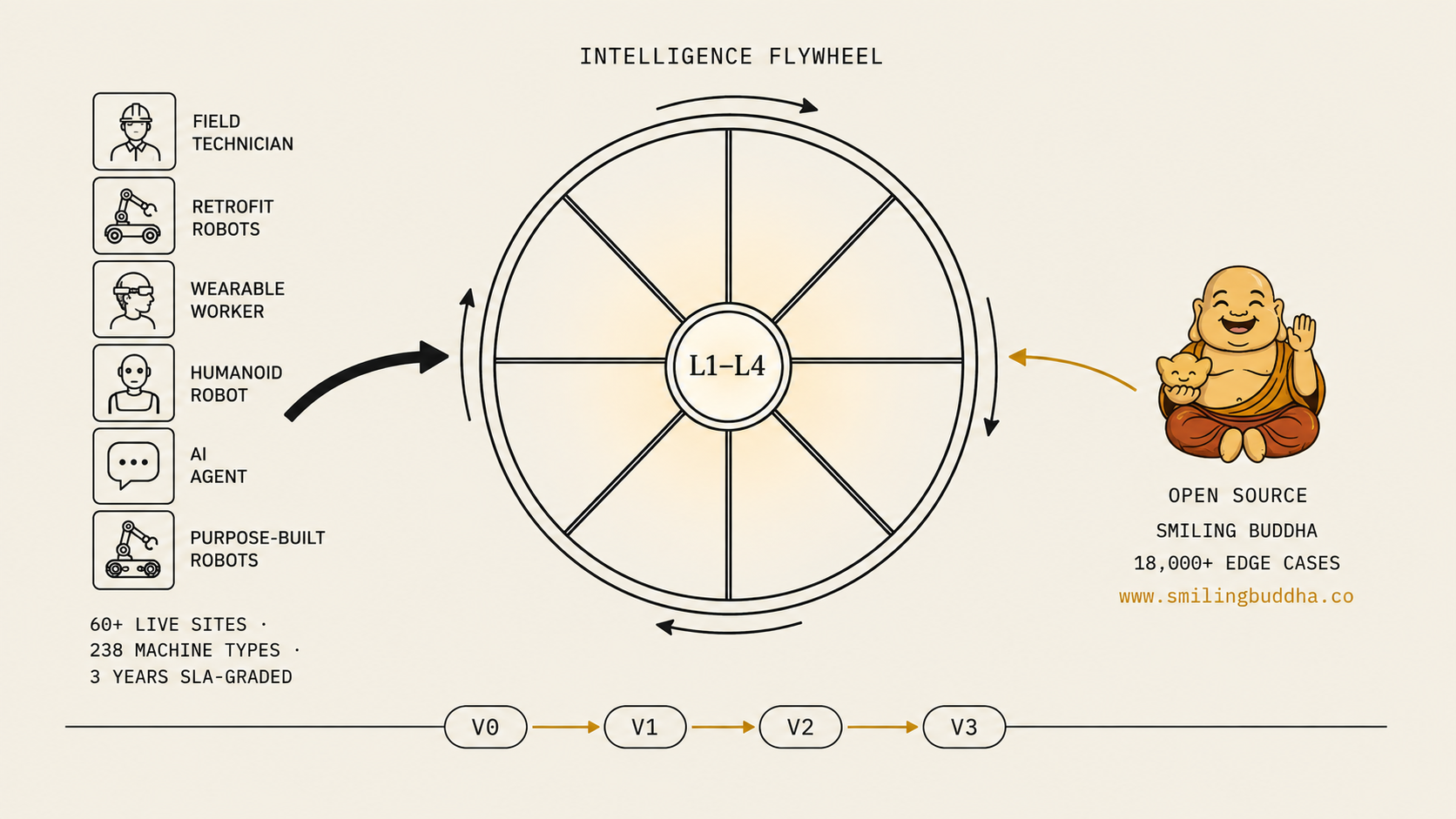
The OS gets smarter the way classical operating systems did — usage accumulates. Each of the six worker classes emits data from live sites, and the flywheel turns it into L1–L4 intelligence, validated V0 through V3.

Data flywheel diagram: six worker classes feeding proprietary deployment data into a central flywheel, with Smiling Buddha open-source edge cases as a secondary input, producing V0 through V3 validated intelligence.
Input A · Proprietary Deployment Data

60+ live sites, 238+ machine types, three years SLA-graded. Real production, not simulation.

Input B · Open-Source Injection
Open Source

Smiling Buddha — 18,000+ edge cases, contributed and validated by the community.

Explore the open library
V0

Synthetic base

Generated from simulation and public data. What labs and academic groups start with.

V1

Single real match

One real production observation confirms a synthetic case. Individual validation.

V2

Multi-embodiment match

Confirmed across sites, machines, and environments. Pattern-level validation.

V3

Novel discovery

Emerges only from live deployment. Cannot be scraped, cannot be synthesized. The moat.

Labs generate V0–V1 in the lab. Only live deployment produces V2–V3. That's the moat — 60+ sites, 238 machine types, three years of SLA-graded operations, plus 18,000+ community-contributed edge cases from Smiling Buddha.
Full Site Automation

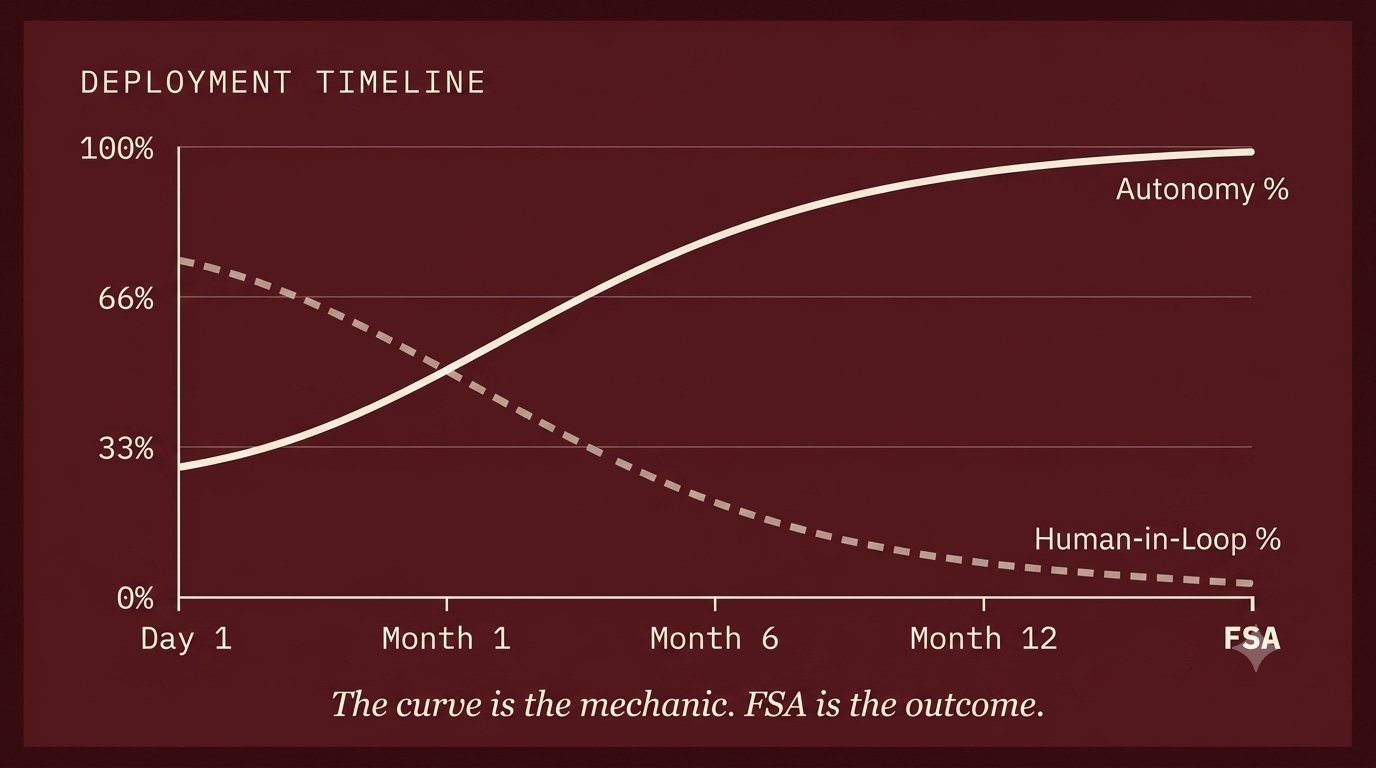
Every capture reduces the next site's Human-in-Loop. Minimal manpower. Maximum automation.

Deployment timeline chart: autonomy percentage rising from Day 1 to Full Site Automation while Human-in-Loop percentage falls from ~70% to under 10%.

The curve is the mechanic. FSA is the outcome.

Human-in-loop is delivered from low-cost operating centers — margin-positive today, shrinking as autonomy climbs.

06 — Why General Intelligence Can't Do This

The general-intelligence bet has a structural flaw.

Foundation models can plan and reason. They cannot sense a scrubber's brush pressure, a haul truck's articulation angle, or a construction site's shifting shadow patterns. The general-intelligence approach spends billions before it works anywhere. The retrofit + L1–L4 approach ships revenue from Day 1.

General Intelligence Approach

One foundation model for all

  • Cannot learn the physics of every machine body from video
  • Sensors and actuators vary too much — no valid unified training set
  • Must work everywhere before it works anywhere
  • 3–5 years to revenue · $2B+ burned first
  • Binary risk: all or nothing
Embodied AI + Operational Intelligence

Retrofit + L1–L4, deployed today

  • One universal hardware kit across 238 machine types
  • Real production data — SLA-graded, joint-level, three years deep
  • Revenue from Day 1 · margin-positive today
  • 60+ sites live · 18,000+ edge cases catalogued
  • Composable: retrofit + purpose-built + humanoid, one OS
07 — Four Verticals

Four site types — one operating system.

The OS runs the same intelligence stack across four site categories. Different machines, different edge cases, one platform.

Live · Chandler AZ

Facilities Cleaning

Revenue-generating. 60+ sites. Reference deployment for the retrofit + L1–L4 architecture.

H2 2026

Logistic Hubs

Material handling and warehousing. Same retrofit kit, MHE-specific edge cases.

2027

Construction Sites

Earthmoving, brick-laying, finishing. Humanoids on wheels + purpose-built AGVs.

2028

Mining Sites

Haul trucks, dozers, drills. Long-tail edge-case severity — where the retrofit moat compounds hardest.

08 — Next Steps

The only Operating System for Physical Work, from hardware up.

Not a research project. A deployable, revenue-generating platform — starting from the hardware up.